Translation and notes by Colleen Culletton
II
Quina petita pàtria
encercla el cementiri!
Aquesta mar, Sinera,
turons de pins i vinya,
pols de rials. No estimo
res més, excepte l'ombra
viatgera d'un núvol.
El lent record dels dies
que són passats per sempre.
II
What a small country
surrounds the cemetery!
This sea, Sinera,
hills of pines and grapevines,
dust in the rials. I don’t love
anything more, except the travelling
shadow of a cloud.
The slow memory of days
that are gone forever.
Espriu, Salvador. Cementiri de Sinera, Les hores. Barcelona, Edicions 62, 1997.
DUST IN THE STREAMS
By Colleen Culleton
This is poem number two, with no title, from a short collection called Cementiri de Sinera (1946), by Catalan poet Salvador Espriu (1913-85). It’s an intimate collection of poems that gently celebrates the place where the poet lived—a small town on the Catalan coast called Arenys de Mar. “Sinera” is an imaginary name that the poet gave to this place; it’s Arenys spelled backwards, replacing the y with an i, for “Sinera.” Arenys de Mar is known for its cemetery, which is way up on a hill with expansive views of the sea. Poem II illustrates the limits of translation, shows how language can be connected to a place, and teaches us how poetry can reveal a world. I’d like to tell you a story about it.
I first read this poem one very hot summer in Barcelona, when I was just learning Catalan. I was frustrated and stuck on the fifth line, “pols de rials.” Because “pols” means dust, and when I looked up “rial” the translation that I found said it was a brook or a stream. But streams can’t be dusty. They’re wet! And my reading came to a standstill.
Around that time, a local reporter heard that there was an American professor hanging around in Barcelona, learning Catalan and studying Salvador Espriu. He offered to take me on a tour of Arenys de Mar. As we were walking through the town and making conversation, he interrupted himself to say, “Of course, here’s the riera, and there’s a rial.” I couldn’t see what he was pointing to, but I was so excited that a mystery was about to be solved for me. I explained my predicament, and the reporter was very pleased to help.
He explained that in Catalan towns along the coast, the riera is the main thoroughfare that passes from the mountains to the Mediterranean. Most of the time, it’s a dry street. But with the right combination of heavy rain and melting snow, the riera will flood with water coming down the mountain and heading out to sea. Rials are smaller streams that are usually side streets until they flood and feed into the riera. This is a geographic feature quite particular to this part of Catalonia, where the riera, lined with benches, shade trees, and cafes, is a public meeting place, like plazas are in other parts of Spain. Rieres and rials only make sense in one place, and yes, they can get dusty. Many coastal communities have rerouted the water’s path, or covered over the riera, in such a way that they are no longer impacted by flooding. That makes this material feature of the culture something that, like the poem says, is “gone forever.” I hope you enjoy the poem and my translation.
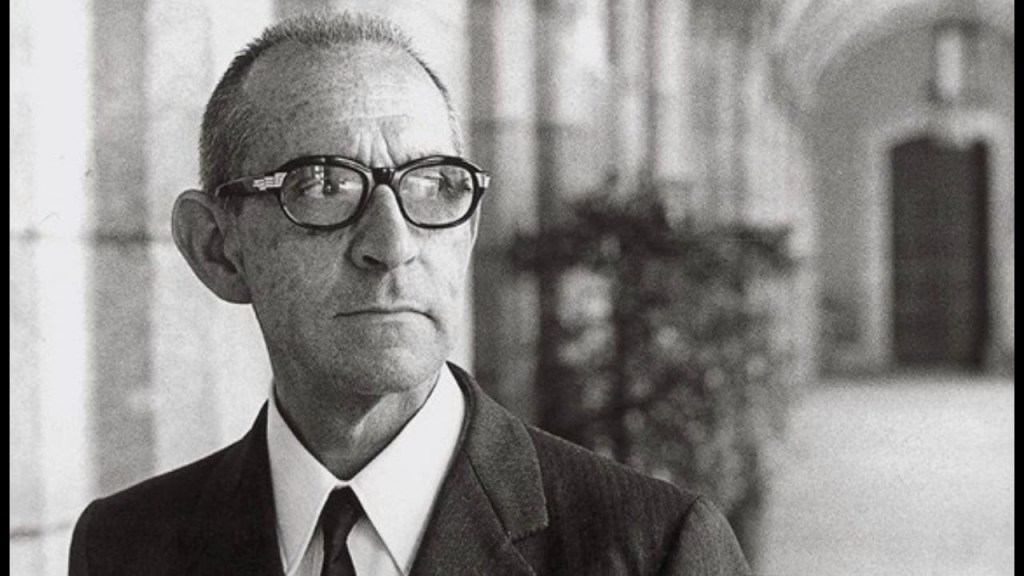
Salvador Espriu (1913–1985) is considered one of the Catalan language’s most significant postwar writers, producing fiction, poetry, and drama. Salvador Espriu was born in 1913. A member of the so-called generation of ‘36—those who were in their twenties at the outbreak of the Spanish Civil War—Espriu became a voluntary exile in his own land.
Colleen Culleton is an Associate Professor of Spanish and Catalan Studies at the University at Buffalo (SUNY). Her first book, Literary Labyrinths: Narrating Memory and Place in Franco-Era Barcelona (Routledge, 2016) examines social memory and the urban landscape, as they are represented in novels from the 1960s and ‘70s. Colleen’s previous research on social space has evolved into an interest in environmental care. Her current research project studies theories of connectedness in the context of globalization.
 Farol: Journal of literature and other arts